

|
|

Page 3 of 3:
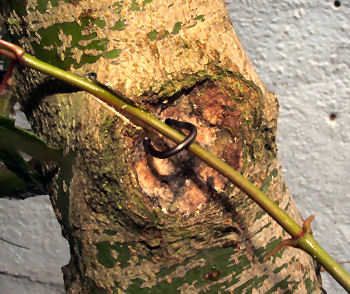
The staple is then placed into the holes...........
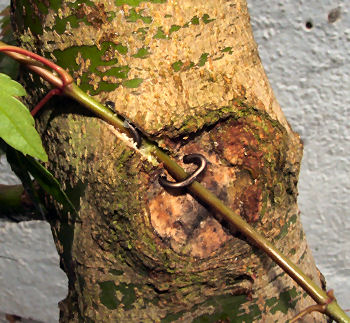
.........and carefully hammered down to firmly secure one end of the scion. A second aluminum wire staple is used to secure the scion within the channel. In the future, when the surrounding area has fully healed, I will remove any visible parts of these staples but it does not matter (and is simpler and easier) if the staple is simply swallowed up by scar tissue.
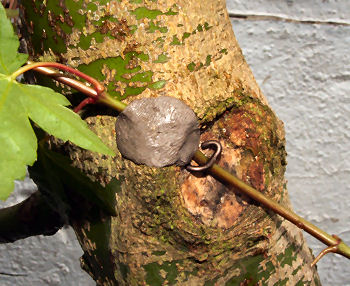
Finally, the entire graft is sealed with cut paste/wound sealant. The scion will now be left to grow as strongly as possible to encourage faster healing. Notice that the leaves on the entry side of the scion have been removed. For the faster grafting you want to encourage as much growth on the exit side (the new branch side) of the graft; to do this remove all leaves and any new buds or shoots that appear on the entry side.
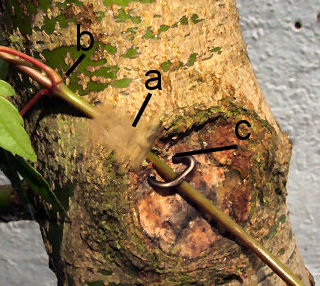
On this particular tree I would estimate that the graft will be ready to separate in late Summer next year.
When the area (a) has healed over you can see that the point of emergence of the scion from the trunk will be exactly where I had originally intended it to be.
As with threadgrafting, notice that the scion has been positioned so that the first internode is very short and the first node or leaf-joint (b) is close to where the new 'branch' emerges from the grafting point. This is very useful for future branch construction, ramification and division.
The staple at (c) holds the scion firmly in place; when the graft has taken, the base of the scion at (c) will be separated and the staple removed.
Severing the Approach Graft
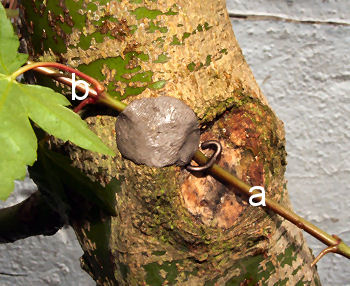
As with thread grafts, when the exit side of the approach graft (b) is noticeably thicker than the entry side (a), you can tell that the scion or graft is being supplied with nutrients from not only the original pathway along the scion, but also via the grafting point. Again, as with threadgrafts, sever the scion a distance away from the point of grafting to allow the tree opportunity to adjust its sap flow and reliance on the grafting point itself to support the scion. Reduce the length of the scion slowly over the course of a few weeks until such time that it can be removed entirely.
Timing
Approach grafts can theoretically be carried out at any time of the year; but the timing is best decided according to the precise needs and risks of the individual graft you are carrying out. In general, I much prefer to carry out approach grafts during the growing season as callusing and wound healing of both the scion and reciprocating branch or trunk is immediate. At this time there is no (or very little) danger of the edges of the channel (into which the scion is introduced) dying back as can happen with some deciduous species during dormancy. Where dieback of the edges of the channel occurs, it can take much longer for the graft to take.
How long does an Approach graft take?
A commonly asked question with regard to approach grafting is ‘How long does the graft take and when can it be severed'? There is no definitive time period that I can state here; so much depends on the vigour and growth rate of the scion and the limb to which the graft is attached, the time of year that the graft is made and the type of tree that is being grafted. For instance, a very vigorous Ficus grafted during the growing season might successfully graft and be severed within just 2 to 3 months whereas a slow-growing coniferous tree might take 3-4 years. However, for the majority of grafts made on fast growing deciduous and coniferous trees during the growing season, successful grafting and separation can be expected within one and two years. Typically the Acer approach grafts I have illustrated in this article were taken at midsummer and will be ready to separate during late Summer next year.
Approach Grafting New Roots for Better Nebari
This article illustrates how to approach graft a new branch onto a bonsai, however, as has already been illustrated above, approach grafting is a particularly useful technique for improving the trunkbase/nebari of bonsai. For further details of this aspect of approach grafting, please refer to "Approach Grafting New Roots for Better Nebari"